Two prompts can describe the same person in the same place and still give completely different pictures. Very often, the difference is the camera. Words about distance, angle and lens tell the AI how to look at the scene, and that changes the feeling of the whole image.
You don't need to own a camera or know photography to use these words. Here are the ones that make the biggest difference, with simple examples.
Shot size: how close are we?
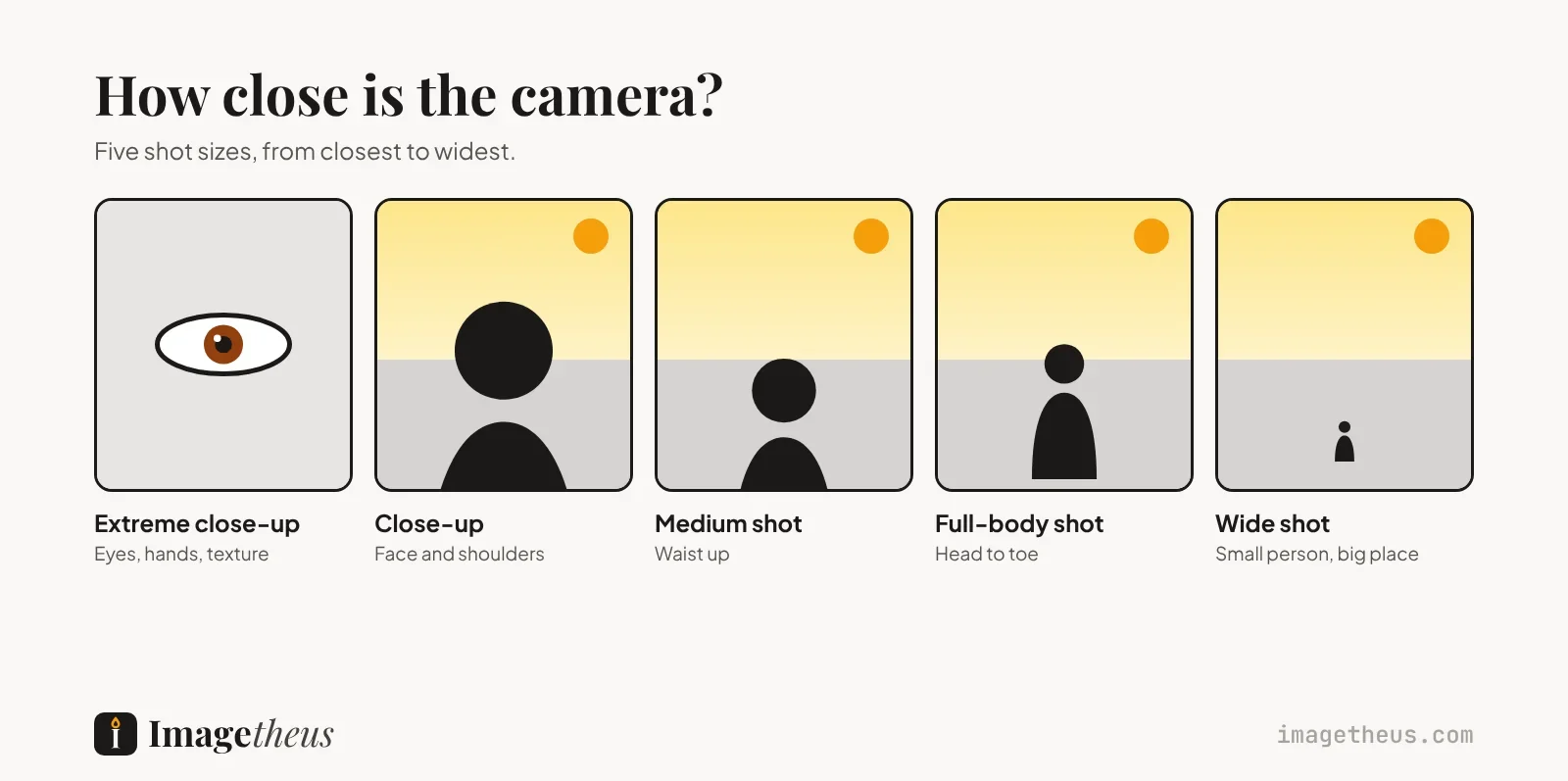
Shot size controls how much of the subject fills the frame.
- Extreme close-up: only eyes, hands or a small detail. Great for texture and emotion.
- Close-up: the face and shoulders. The classic portrait.
- Medium shot: from the waist up. Shows expression and clothes together.
- Full-body shot: the whole person, head to toe. Good for fashion.
- Wide shot: the person is small and the place is big. Good for mood and storytelling.
Wide shot of a lone cyclist crossing an empty bridge in thick morning fog
The word "wide" tells the AI that the fog and the bridge matter as much as the cyclist.
Camera angle: where is the camera?
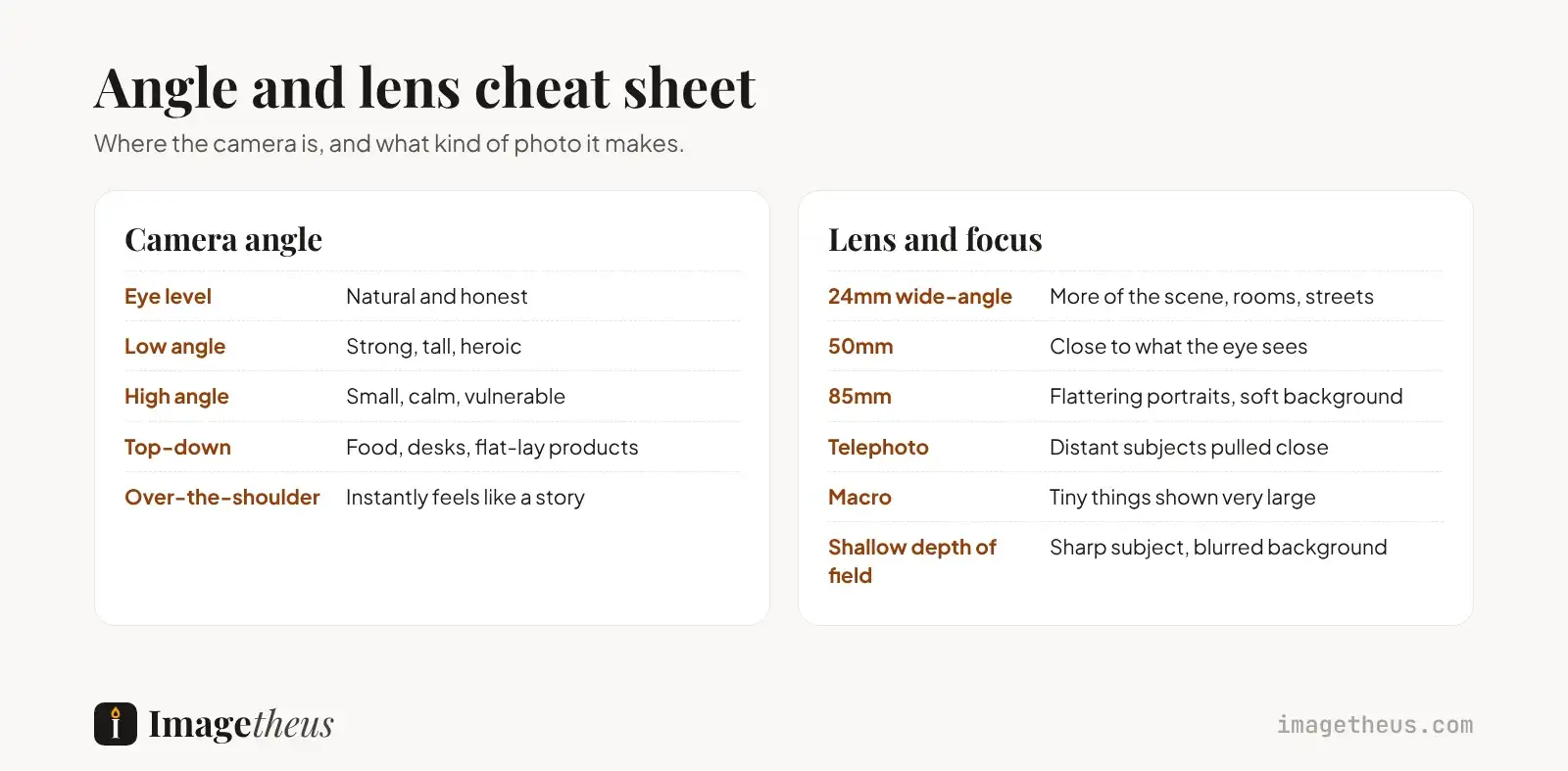
- Eye level: natural and honest. The default for most portraits.
- Low angle: the camera looks up. The subject feels strong, tall or heroic.
- High angle: the camera looks down. The subject feels small, calm or vulnerable.
- Bird's-eye view or top-down: straight down from above. Perfect for food, desks and flat-lay product shots.
- Over-the-shoulder: we see past one person towards something else. It instantly feels like a story.
Lens words: the "look" of the photo
AI tools have learned what photos from different lenses look like, so lens words work even though no lens is involved.
- 24mm or wide-angle lens: more of the scene, a little stretching at the edges. Good for rooms and streets.
- 50mm lens: close to what the human eye sees. Natural and simple.
- 85mm lens: flattering portraits with a soft background.
- Telephoto lens: distant subjects pulled close, background squeezed in. Good for wildlife and sport.
- Macro lens: tiny things shown very large, like water drops or insects.
Focus and depth: what is sharp?
- Shallow depth of field: the subject is sharp and the background is softly blurred. It separates the subject and looks professional.
- Deep focus: everything is sharp, from front to back. Good for landscapes and busy scenes.
- Bokeh: soft round circles of light in a blurred background, often from city lights or fairy lights.
Composition: where things sit in the frame
- Centred and symmetrical: calm, formal and strong. Great for doorways, corridors and churches.
- Rule of thirds: the subject sits a little to one side. Feels natural and leaves space.
- Negative space: lots of empty sky, wall or floor around a small subject. Feels quiet, lonely or elegant, and leaves room for text on posters.
- Framed by: "framed by a window", "framed by leaves". A natural frame draws the eye to the subject.
Putting it together
Before:
a violinist in a cathedral
After:
Wide shot of a violinist in a long black dress playing alone in the centre aisle of an empty stone cathedral, centred and symmetrical composition, eye level, deep focus, a single shaft of light from a high window, quiet and powerful mood
The scene is the same, but now the AI knows how far away to stand, where to place her, and what should be sharp.
Common mistakes
- Mixing opposites: "extreme close-up, full-body shot" confuses the AI. Pick one shot size.
- Too many lens words: one lens and one focus word is enough.
- Forgetting the background: a shallow depth of field still needs a background to blur, so describe it.
Practise with real prompts
Open a few prompts in our People & Portraits and Film & Cinematic categories and look for the camera words. Then try changing just one of them and compare the results.
